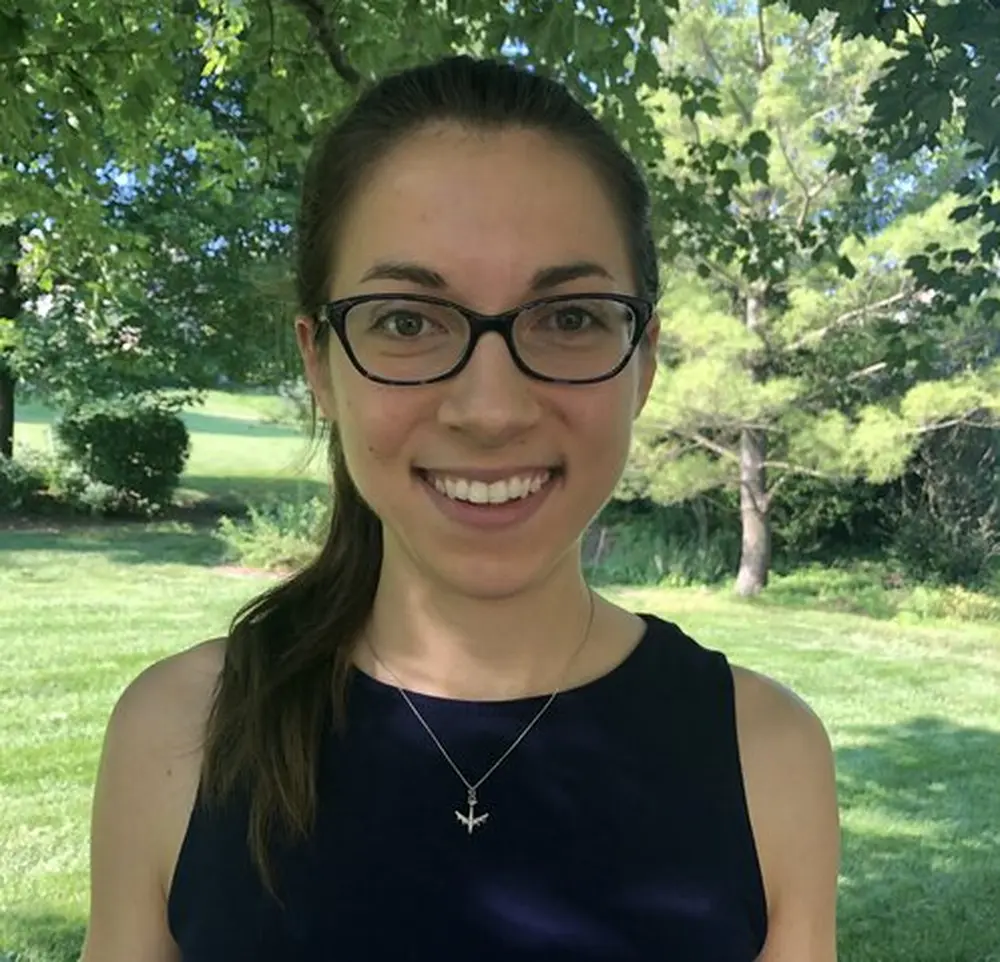
Noel Brindise is a new alumna working at the Johns Hopkins Applied Physics Lab in Laurel, Maryland. She explains why she chose to study both German and aerospace engineering and how she’s using what she learned in her humanities classes in a hyper-technical field.
Noel Brindise (BS/BA ’19; MS ’21; MA ’24; PhD, ’25) knew she loved two things going into college: German and engineering.
She started taking German in middle school and quickly fell in love with the language. On the other hand, she had always enjoyed math, which made engineering seem like the obvious path. Part of her felt she had to pick between the two.
Instead, she decided to do both.
“There’s this idea that you need to pick—that you can’t follow all of your passions or do everything you’ve ever wanted—and sometimes that’s true,” said Brindise. “For me, pursuing a degree in German was a way of formalizing my passion and pushing myself to make time for my hobby—something I love a lot—by actually getting a degree in it.”
Brindise thought about doing a minor, but with her AP credit, she would only have needed to take a few courses.
“That just wasn’t enough German for me,” she said.
With the help of the Department of Germanic Languages & Literatures, Brindise developed a plan to pursue a dual degree in Germanic studies and aerospace engineering. Her classes in the Germanic department provided a welcome change of pace from her engineering workload and allowed her to form a deeper connection with the German language, as well as develop a greater understanding of languages as a whole.
“The more languages I encountered, the more I realized how many things we take for granted with the English language,” said Brindise. “There are so many ways humans can communicate and so many forms that can take. German was my first introduction to that.”
From there, she went on to pursue an MA in German and an MS and PhD in aerospace engineering—all at the University of Illinois.
“I had really great connections here and people who understood me,” said Brindise. “If I had gone to another university for my PhD, it probably would have been fine, but I worked very intentionally with the Germanic department to pursue my MA. I also liked that it was a strong program, and there were a lot of special people there that I wasn’t ready to leave.”
Now, Brindise is working at the Johns Hopkins Applied Physics Laboratory in Laurel, Maryland, where she is an AI/Autonomy researcher.
“I love my job and get to be creative every day, often proposing new work and helping guide the direction of my projects,” said Brindise. “A typical day might be spent at my desk, visiting other parts of the lab and collaborating with other scientists and engineers, or out in the field doing flight tests.”
Brindise has been able to draw from her interdisciplinary studies both in her day-to-day work and her research topic of interest: Explainable Autonomy.
“The work I do now requires a lot of creative thought, precise communication, and thoughtful presentation of ideas,” said Brindise. “My education helped prepare me for all of those things. It’s also given me a very valuable perspective on my research. Explainable Autonomy is all about bridging the gap between humans and AI, a task that shares a lot of qualities with translation studies and communication. I feel like I’m taking a lot of what I did at Illinois with me. I’m not leaving anything behind.”
Combining fields that seem wildly different on the surface also helps to bridge a different gap, this one between humans.
“I think there can be a pretty big disconnect between humanities and technical studies,” said Brindise. “It can be hard for people from the two sides to even communicate. Someone on the technical side might hear vague suppositions on how we can better understand each other and think, ‘Okay, that’s cool, but I do motion planning for robots. I don’t know how that’s related to me.’ What I’ve done on the German side has given me a different perspective on the problems being discussed on the humanities side.”
Brindise said it’s that perspective that’s made her a better researcher.
“Something that tends to be neglected in technical studies is if you don’t have good communication, and you don’t put things in social context, your work could be worse than useless,” she said. “Just because you come up with an interesting idea doesn’t mean it’s going to help anybody. Different people understand things differently, communicate things differently, have different needs, and bring different things to the table. I think the question to ask yourself is, ‘How do we do this in a human-centered way, instead of just doing things that sound cool or are technically sound?’”
It's also made her a better human.
“It feels like I got to learn about humans and humanity by studying languages,” said Brindise. “Languages are such a fundamental part of being human. The more you understand how they work, the more you understand how people work. I think it opened up a deeper well of empathy in me, one I may not have had otherwise.”