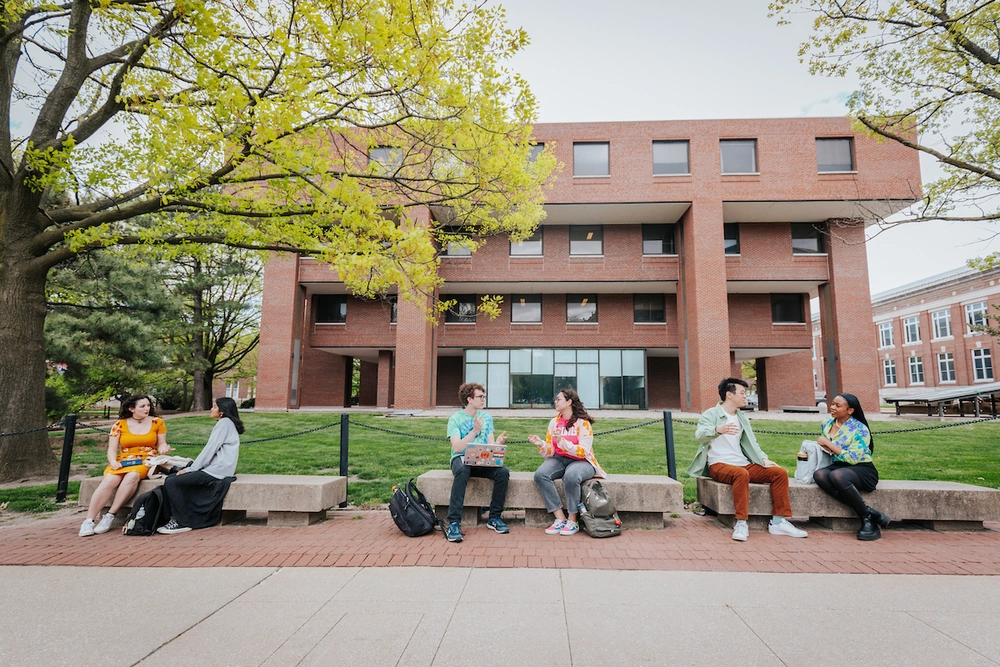
Four students are working towards a better future with the help of the Frances E. Smith Scheidel Scholarship.
These awards are given to undergraduate students majoring in one of the school's academic units who have overcome significant hurdles to achieve academic success. The scholarship fund was established in 2007, thanks to the generosity of Mrs. Frances Scheidel, whose personal history included returning after a significant interruption to complete her Illinois degree.
This year's recipients include Sister M. Elizabeth Grace Donahue, Matthew Elifson, Maya Strong, and Jadzia Taborski.
“Receiving this scholarship is a great assistance and an honor, for my community and for myself,” said Donahue. “It will help immensely with the cost of tuition during my time here at Illinois, as we rely on the cumulative work of the sisters and donations to afford any higher education for our sisters. Personally, having returned to school unsure of how difficult or challenging it would be many years post-high school, I am truly so grateful to have been considered and chosen.”
Donahue is a returning student completing a double major in classics—with a concentration in Latin—and Italian. With the help of the Scheidel scholarship, she’s making the most of her time at Illinois and preparing for the career she’s been called to as a Catholic religious sister. Her plan is to teach Latin at the secondary education level, as well as translate different religious Franciscan sources from Latin and Italian for her community of Franciscan sisters.
“I don't think I would have ever been able to achieve the proficiency needed for these goals without the education I've been receiving here,” said Donahue. “Starting with a 'trial-run', if you will, with a tutor through the U of I, and moving into the program with amazing professors who really care and will bend over backwards to see you succeed, it has already been a great journey.”
For Elifson, a senior majoring in computer science and linguistics with a minor in Spanish, his journey began when he was a child living with his grandmother.
“She was from Uruguay but learned many languages beyond Spanish during her humanitarian volunteer work around the world, which definitely sparked my own interest in linguistics,” said Elifson. “I [also] think computational methods can be very helpful in linguistic efforts like data analysis, classification, and especially preservation and modelling of low-resource minority languages. While I am mindful of the ethical challenges in mainstream AI and LLM research, I do think that there’s a lot of value in the broader scope of computational linguistics and language modeling.”
Now, he’s using the knowledge and support he’s gained from Illinois—and the Scheidel scholarship—to get involved in research and pursue a research project of his own.
“This summer, I did a machine learning internship at the Idaho National Laboratory focusing on natural language processing and applying it to nuclear reactor risk mitigation,” said Elifson. “I’ve also been able to start working on a project to train a neural machine translation model for a minority, low-resource language. I really appreciate the structure my major provided, and I like how it encourages students to explore their own interests within linguistics as a whole, given how vast the field is. I hope to continue my work after graduation and hopefully produce something useful!”
Strong, a junior majoring in neuroscience and linguistics, is preparing for a career as a medical scientist with the help of the Scheidel scholarship and her combination of majors.
“There are many unanswered questions concerning the neurological bases of communication and processing disorders,” said Strong. “I decided to study neuroscience and linguistics because beyond providing a foundation to explore these questions, I enjoy studying each separately, as well. I couldn’t see myself studying the biological basis of the mind without the unconscious mechanisms behind human communication, and vice versa.”
Both are constantly evolving fields—something that piqued Strong’s interest as she herself looks towards the future.
“Both neuroscience and linguistics are fields that are heavily impacted by modern technology and research at a fast rate, especially in the 21st century,” said Strong. “It makes me look forward to what we have yet to learn in either field, as well as the area where they intertwine.”
For more information on the Scheidel Scholarship, visit the SLCL website. To learn more about investing in the future of our students, please visit our giving page or contact Ai Niemeyer.