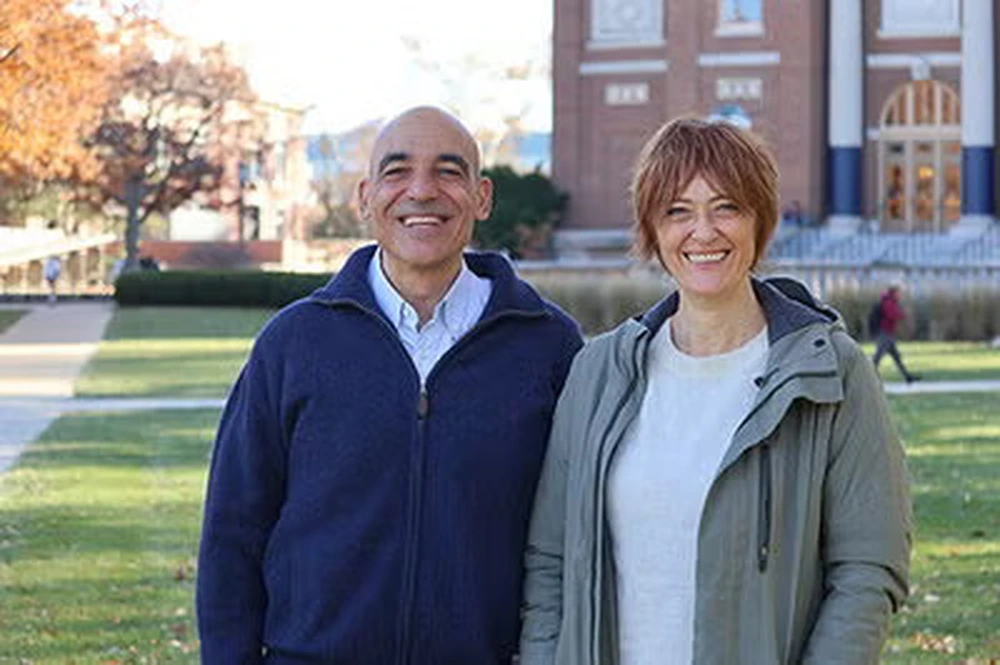
Miguel Ángel Galindo (MA, ’91, Spanish; PhD, ’97, Spanish) and Nerea Muguerza (MA, ’98, Spanish), longtime resident directors of the Illinois in Granada program in Granada, Spain, recently returned to the University of Illinois for their first visit in a decade.
The Granada program is an immersive language and culture program where students take classes (earning up to 19 credits at Illinois), live with a host family, and engage with the community in Granada. Since 1997, nearly 3,000 students have participated in the program, including over 2,000 U of I students.
Students from the University of Wisconsin, University of Michigan, University of Illinois Chicago, and Indiana University have participated through the U of I program as well. Administrators say that the program has long held a strong alumni base, with word of mouth among students helping to build its popularity.

Galindo was a lecturer of Spanish and Catalan at U of I when he was offered the resident director in Granada position by U of I’s International Programs Study Abroad Office. He was brought onto the program not just for his ability to speak Spanish and English, but his understanding of both the Spanish and American academic systems.
Galindo said it was nice to move back to his home country after many years in Illinois. He also has ties to Granada in particular.
“I’m from the Barcelona area, but my parents are from a little town near Granada,” he said. “I never thought that I was going to end up living and working in the place where my family comes from originally. … It’s nice there’s a connection there.”
Muguerza joined shortly after. Originally from the Basque Country in northern Spain, she moved south where the program was starting.
“I thought, if the school is going to have a good number of new students, maybe they need someone else,” she said. “New teachers.”
It just so happened that Galindo was in need of a new assistant. “It’s like being at the right time, in the right place,” Muguerza said.
The two had actually met in Illinois, as they were both pursuing graduate studies at U of I.
“Illinois is home for both of us,” Galindo said.
The biggest change the program has seen happened fairly recently. In the summer of 2024, Illinois in Granada moved from CEGRÍ, the International Center of Higher Learning in Granada (a private local provider) to the Modern Language Center (CLM) at the University of Granada. Though this move was prompted by CEGRÍ’s closure after its director retired, it brought positive change for the program.
“Something that needed to expand and be changed was the fact that the students were not getting any interactions with local students or other [international] students, because [CEGRÍ] was just our program,” Galindo said. During that time, the provider had been partnering only with study abroad students coming via the Illinois program, meaning that classes were held with the same group of peers.
“Students would always mention, ‘We love the classes, but we miss interacting and making friendships with other students,’” Galindo said.
Moving into the CLM mixed Illinois students with local students from Granada—called Granadinos in Spanish—and other international students from all over the world.
Galindo and Muguerza have been the backbone of the program for nearly its entire run, and they have program alums all over Illinois and the U.S. — some of whom end up working with study abroad programs in their careers.
Brady Hughes (BA, ’17, Global Studies and Spanish; MM, '24, musicology), senior academic advisor for the Department of Spanish & Portuguese, is a program alum. So is Amelia Kolany (BA, ’23, Spanish and psychology), who works for study abroad provider IES, and alum Gabby Contreras (BS, ’25, Spanish and psychology), who has joined the University of North Carolina at Chapel Hill as a study abroad advisor.
Hughes participated in the program in the fall of 2016. He said he is grateful for Galindo and Muguerza’s work, and he considers it a privilege to now work with them in the department.
“Without a doubt, the most consistent feedback I hear from students returning from Granada is how much more confident they feel in their Spanish language abilities, how much fun they had during their time abroad, and how supported they felt by Miguel Ángel and Nerea,” Hughes said.
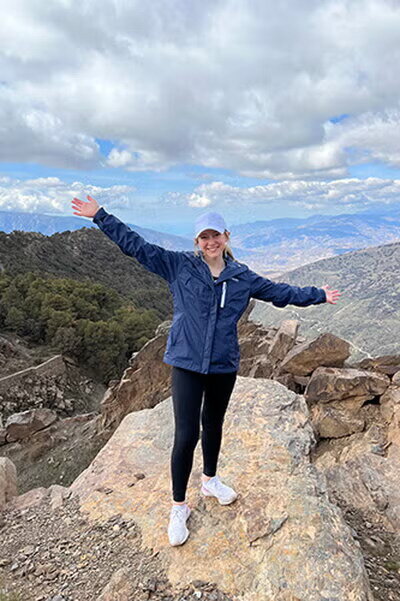
Kolany took part in the program in spring of 2022. She credits the trip for leading her to work at IES, a study abroad organization in Chicago.
“I really got to know my classmates and the city, which has so much fascinating history and many amazing things to see,” Kolany said.
Another is Stephanie Lepak (BA, ’24, global studies and Spanish), the academic program coordinator for U of I’s LAS International Programs, where she also acts as the lead advisor for the Granada program.
“[Galindo and Muguerza] both have a very welcoming energy, a very warm energy,” Lepak said. “Students feel comfortable coming to them with anything.”
That energy is especially valuable for students finding their footing in a different country. Galindo and Muguerza draw on their own experience as international students at U of I to guide and support them.
“I always like helping others when they go through difficulties, when they’re abroad trying to adjust and everything,” Galindo said. “We can give a hand and help them have a smoother way adjusting. It’s much better than just going by yourself and hitting walls constantly, learning the hard way.”
Galindo and Muguerza shared a story from last semester, when they had a lot of leftover Christmas candy, which they leveraged as an opportunity to check in and chat with the students.
“We told the students to come and get some candy,” Muguerza said. “Sometimes they came, said, ‘Hi, how are you?’”
“And they will walk straight towards the box of candy bars, grab one, and be like, ‘See ya!’” Galindo continued. Suddenly, the candy became a bribe to get students to chat. “‘You only get candy if you sit down for two minutes,’” he reenacted with a laugh. “‘How are you doing? Do you like your classes? This candy has a price.’”
Lepak had many fond memories to share about her time in Granada. One was a two-day mountain hiking trip Galindo took students on.
“That was wonderful,” Lepak said. “I will never forget that trip.”
An avid hiker, as Lepak called him, Galindo often let students tag along on his adventures. “It’s a nice way of showing them the surroundings, the nature of Granada,” Galindo said.
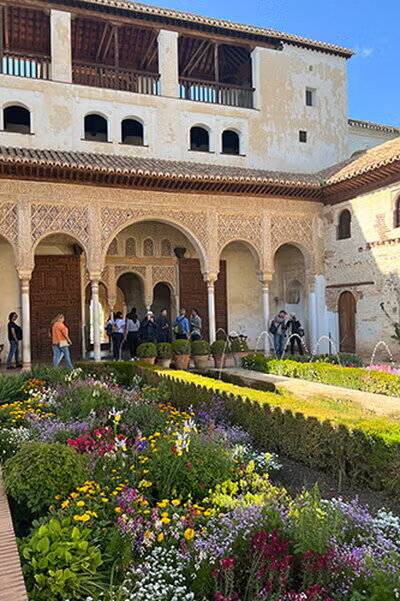
Granada architecture shows snapshots of history as well. Galindo and Muguerza said you could go down one street with architecture resembling Morocco, then go down another street with more Neoclassical style. Moorish, Renaissance, Gothic, and Baroque styles can be seen in the city.
“You don’t have to look up pictures or slides to study something,” Galindo said. “The city is a museum.”
Galindo said students also learn about themselves and their own culture by comparing it to the culture of Granada. For some students, it’s a big adjustment to go from living independently on campus to living with a host family. Meal times are significantly later, and sobremesa — the time spent around the table after a meal to converse and relax — is a rather stark contrast to the hurried grab-and-go culture many U.S. college students live in.
Then again, Muguerza said, students also learn that Granada culture is not monolithic. As with any culture, there are differences within. She said time spent abroad can help people learn not to judge, as they get to know people as people rather than relying solely on their portrayal in media.
The program thus offers an experience that can be beneficial to anyone — not just students studying Spanish. Thanks to the move to the CLM, a wider range of classes are available in the Illinois in Granada program that expand beyond the primarily Spanish language coursework long offered through CEGRÍ. Galindo and Muguerza hope this will bring in students from all different majors to take classes, in Spanish, related to their field of study, and keep the program thriving.
“We love what we do,” Galindo said. “That’s why we’ve been involved with the program and the university for so long.”
Editor's note: This story first appeared on the College of LAS website.